

LASD’s award-winning STEM (Science, Technology, Engineering, Math) education is implemented every day at our seven elementary schools. Each student increases their understanding of STEM through collaborative projects, individual exploration, creative experiences and time with experts.

- STEM learning is incorporated into classroom lessons.
- Students use their critical thinking and problem-solving skills through STEM projects.
- Students are invited to participate in several school-wide STEM Design Challenges.
- Students can create and showcase a project at their school's STEM Expo.
- A well-equipped STEM Lab and/or Makerspace is available at every school for class projects or individual student pursuits during Lunch Club.
- STEM Instructional Support Teachers (ISTs) provide expertise in all STEM areas at each school.

STEM Design Challenges
All elementary schools offer three school-wide STEM Design Challenges each school year, to encourage school community building. For example, the “Egg Drop” was the first Design Challenge of the year. Students were challenged to create a prototype that protects a care package (aka. egg) dropped from the school roof.
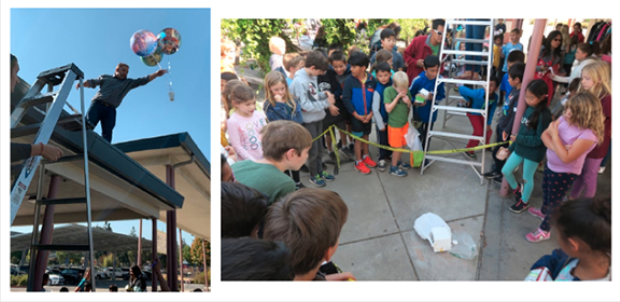
Covington students wait in anticipation as Principal Spenader drops their care package from the roof. Over 100 students participated!
Coming up next: a school-wide Valentine's Day STEM Design Challenge. Look for more information in your school's newsletter.
Classroom Learning
Interesting STEM projects happen at every grade level, TK-6. Here are a few examples:
1st Grade - Gingerbread Man Design Challenge
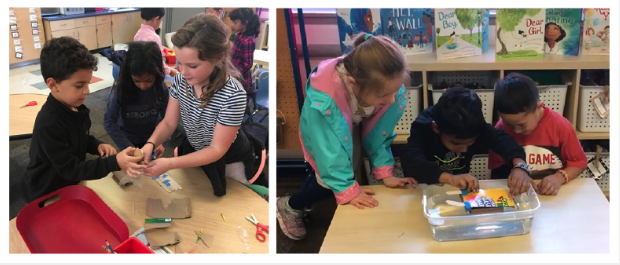
After reading several different versions of The Gingerbread Man, our first graders work in teams for our Gingerbread Man Design Challenge. Together, they use recyclable materials and design prototypes that could help the Gingerbread Man stay dry when placed in a tub of water.
3rd Grade - Magnet Unit
3rd-graders learn about the science of magnets by exploring magnetic levitation trains. Maglev trains move by using magnets instead of wheels. Students use the engineering design process to design, test, and improve their tabletop maglev transportation systems.
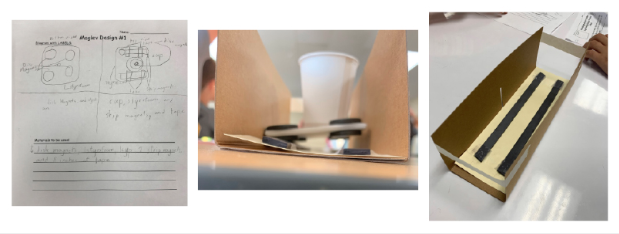
“This was a track that we made using magnets. It used the opposite sides of the magnets to repel and they push against each other so the car (cup) could float and move. It was supposed to be a floating car like a maglev train in Japan.”, – 3rd grade student
4th Grade - Makey Makey Project
4th-graders design and build a controller and drawing app with a special focus on usability for individuals with motor disabilities. They use the coding program Scratch along with an exciting tool called Makey Makey. Makey Makey allows them to turn any electrically conductive object into a keyboard controller, opening up a world of possibilities for students to design their device. They utilize coding skills, practice engineering and design thinking, and build empathy to create something unique through this multi-week project in each school’s STEM Lab.
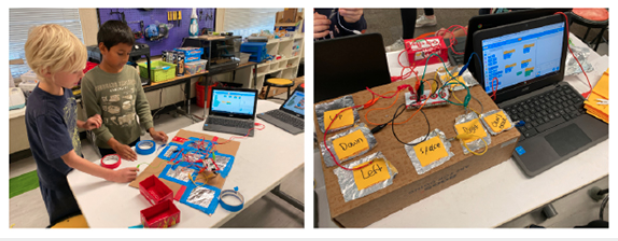
“I learned that an assistive device helps humans in their everyday lives, especially the elderly or disabled. But assistive devices don’t only help the elderly and disabled, they can help everyone!”, – 4th grade student
6th Grade - Popsicle Cooler Project
In the popsicle challenge, students apply their understanding of thermal energy transfer (conduction, convection, and radiation) to design a container that can keep popsicle cold in warm conditions. Students plan a "vacation" to Hawaii where they will hike Diamond Head, bring along a popsicle, and keep it cold so they can eat it at the top. The popsicle must be stored in a container that is small enough to fit in a backpack and is designed to withstand 84-degree weather for approximately an hour and a half.
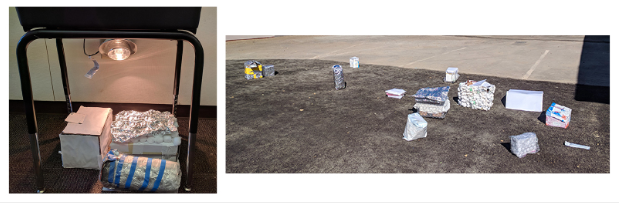
Depending on the weather at the time of testing, student devices are tested on the blacktop or under heat lamps.
As every LASD student participates in STEM projects, they develop curiosity, confidence, persistence, and problem-solving skills.
STEM Expos
Students in grades TK-6 are invited to design and create a hands-on project of their choice and showcase it at their school’s STEM Expo. They can work in class or at home, individually, with peers, or with an adult. Project categories include Rube Goldberg, Invention, Reverse Engineering, Robotics, Scientific Inquiry, and Wearable Designs.
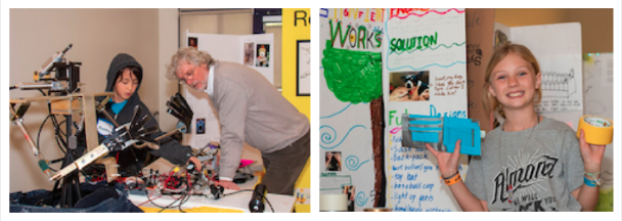
Projects are reviewed by community volunteers and each student receives appreciation and feedback.
Well Equipped STEM Labs
As future designers and engineers, students learn and integrate new tools to enhance their skills. They can utilize their school’s STEM Lab, with resources to learn about robotics, engineering, 3-D printing, and more. The STEM Lab is available for class projects, or individual work during Lunch Club.
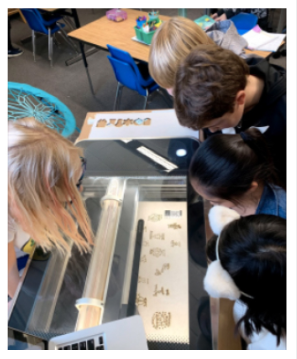
The district recently acquired a Glowforge laser cutter. This tool lets students prototype and learn quickly the effectiveness of their design by enabling shorter build times. They can then apply their failures and successes to build a more viable product, mirroring real-world experience.
LASD Teachers Keep on Learning!
Our teachers are continually expanding their STEM knowledge and skills to effectively implement the best educational practices for our students.
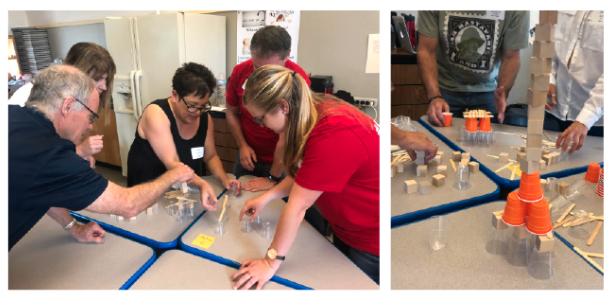
Teachers learned the difference between a design challenge and the design thinking process during the September professional development day.
LAEF helps make STEM a reality in our schools by funding STEM ISTs. Thank you for contributing to LAEF this school year.
For technical questions and comments regarding this website, including accessibility concerns, please contact the Webmaster. Back to Top